 ESPCI web site
Internship – Design and testing of hydrogel prototypes for improved skin-probe coupling in ultrasound imaging
Background:
Ultrasound is the most wide-spread imaging modality in the clinic, with the advantage of being portable and moderately inexpensive. However, it has traditionally suffered from the trade-off between resolution and framerate, limiting its resolution to the order of 1mm. Introduced in 2015, a novel imaging modality called ultrasound localization microscopy (ULM) has allowed considerably improving resolution and acquire detailed maps of the vascular system of organs, down to dozens of micrometers (Errico et al 2015).
This is of particular relevance in the understanding and detection of pathologies that begin in the small vessels, which are currently not visible using state-of-the-art modalities (MRI, CT scan). This includes notably angiogenesis in cancer, diabetes, vascular dementia and other dementias such as Alzheimer’s disease.
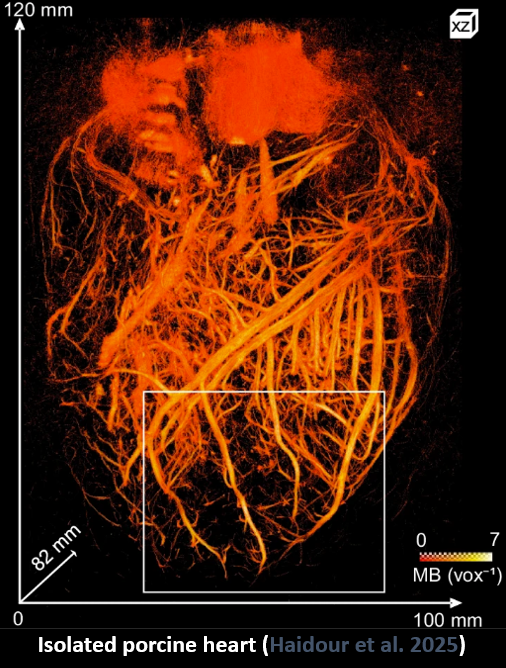
Originally developed in 2D, ULM has been extended to 3D for small animal organs (Demeulenaere et al. 2022) and more recently to large animal organs (Haidour et al. 2025). At Physics for Medicine (ESPCI Paris, CNRS, INSERM), the Ze[US] project aims at building an ultrasound scanner able to image entire human organs in 3D with unprecedented resolution (heart, liver, brain…).
Objectives:
Ultrasound imaging heavily relies on a mechanism called acoustic coupling, which is the ability to transmit ultrasound waves at the interface between two media. When a probe is placed directly onto the skin, some air can get trapped at the interface. Since the ultrasound impedance of the air is very different than that of the soft tissues or the probe, most of the energy emitted by the probe is not able to cross the layer of air, resulting in poor imaging quality. Traditionally, this issue is overcome by depositing a thin layer of gel between the probe and the skin, which removes the remaining air and enables the ultrasound waves to be transmitted with minimal loss.
However, the recent development of 3D probes to image large organs has raised new challenges. These systems are typically much larger than traditional ones (~1cm vs ~10cm), resulting in a complex coupling interface with the body. A common strategy is to attach a membrane to the probe and fill it with water, to adapt to the irregularities of the body (Haidour et al. 2025). This comes with multiple limitations, including lack of practicality in a clinical context as well as additional time and effort to ensure that the water had been degassed properly.
In this context, hydrogels are good candidates for replacing traditional approaches:
- They can yield an acoustic impedance very close to that of water and the soft tissues of the body.
- Their mechanical properties can be tuned in many different ways and designs, such as thin films (Moreau et al. 2016) or highly anisotropic fibers (Bach et al. 2013).
- Hydrogels are highly biocompatible, as demonstrated in numerous medical applications, such as tissue engineering (Liu et al. 2017) and adhesives (Michel et al. 2019).
- The possibility to play with different states – liquid, gel – and to choose activators for state transition (temperature, light).
The main objective of the internship is to develop hydrogel prototypes to find innovative approaches for the coupling. More specifically, the intern will have to consider multiple aspects:
- Work with the C3M team (ESPCI Paris, CNRS) to find relevant hydrogel candidates, based notably on their mechanical properties.
- Characterize these candidates acoustically at Physics for Medicine.
- Design easy-to-use prototypes fitting the experimental and clinical context of ultrasound 3D imaging of large organs.
- Test and characterize the performance of such prototypes in vitro.
Additionally, the intern will be able to work on the characterization of the probes designed in the Ze[US] project. These probes will be used in various in vitro set-ups to evaluate their performance and the ability to combine them together in a multi-probe imaging modality.
Skills & knowledge required:
We are looking for a student in the final year of a Master’s degree or engineering school with a solid background in experimental and/or digital physics. Knowledge of programming (MATLAB, Python) will be useful. An interest in medical imaging and biomaterials is definitely an asset.
Supervision:
Mickael TANTER (Inserm research director at Physics for Medicine), Laurent Corté (Professor at Mines Paris PSL and ESPCI Paris PSL (C3M)), Paul GUILLOT (engineer, PhD student at Physics for Medicine).
Duration:
Internship suitable for a student in M2 / final year of engineering school / gap year, ideally starting in March/April 2026 for 5-6 months.
Location:
The internship will take place at two laboratories (mainly at Physics for Medicine)
- Physics for Medicine, PariSanté Campus, 2-10 rue d’Oradour sur Glane, 75015 Paris
- Chimie Moléculaire, Macromoléculaire, Matériaux (C3M), ESPCI Paris PSL, 10 rue Vauquelin, 75005 Paris
Email:
mickael.tanter@espci.fr ; Laurent.corte@minesparis.psl.eu ; paul.guillot@espci.fr


